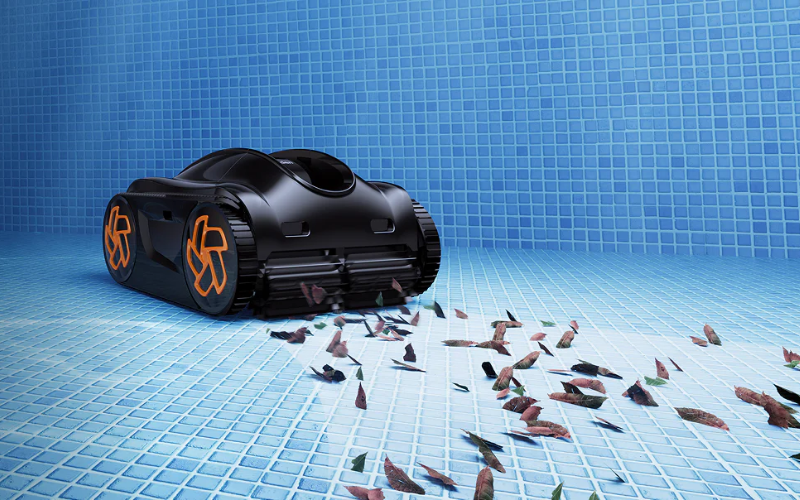
Keeping a pool clean involves dealing with many different types of debris. Some materials float on the surface. Others sink quickly to the pool floor. Leaves may gather in corners, while sand and fine particles settle slowly across the bottom.
Because debris varies in size and weight, cleaning equipment must be able to handle multiple types of contaminants. A system designed only for large debris may struggle with fine dust. Likewise, equipment built for small particles may clog when leaves accumulate.
Robotic pool cleaners are designed to manage this variety more efficiently. By combining brushing, suction, and internal filtration, these devices can remove leaves, sand, and fine debris in a single cleaning cycle.
Understanding how robotic cleaners handle these different materials helps explain why they have become a popular solution for residential pools.
Why Different Debris Requires Different Cleaning Methods
Not all debris behaves the same way in water. Leaves and twigs tend to float briefly before sinking or drifting toward pool edges. Sand and small stones settle quickly on the floor.
Fine particles such as pollen or dust can remain suspended in the water for longer periods. Eventually they settle into thin layers along the pool surface.
Because of these differences, a pool cleaner must perform several tasks at once:
- Lift debris from the pool surface
- Prevent particles from drifting away
- Capture material before it resettles
A robotic cleaner accomplishes this through a combination of movement, brushing, and filtration.
Removing Large Debris Like Leaves
Leaves are one of the most common forms of pool debris. They can enter the pool from nearby trees, wind, or seasonal changes.
Large debris often gathers along pool edges, steps, or corners where water circulation slows. If left unattended, leaves may break apart and release smaller particles into the water.
Robotic pool cleaners address this issue through strong suction and large debris intake openings. As the cleaner moves across the pool floor, it lifts leaves directly into the internal filter basket.
Because the debris is stored inside the cleaner, it does not travel through the pool’s plumbing system. This helps prevent clogging in the main filtration system.
Large debris baskets also allow the cleaner to collect more leaves during a cleaning cycle without needing to stop frequently.
Handling Sand and Heavy Particles
Sand is another common contaminant in swimming pools. It often enters the water through wind, nearby landscaping, or swimmers bringing particles into the pool on their feet.
Unlike leaves, sand sinks immediately. It spreads across the pool floor in thin layers that can be difficult to remove with weak suction.
Robotic cleaners use rotating brushes and suction systems to lift sand from the surface. The brushes loosen particles that are stuck to the floor or trapped in textured pool surfaces.
Once the sand is lifted into the water flow, suction pulls the particles into the filter chamber.
Because robotic cleaners operate close to the pool floor, they can capture sand quickly before it spreads further.
Capturing Fine Debris and Dust
Fine debris presents a different challenge. Small particles such as pollen, dust, and tiny organic material may remain suspended in the water before settling.
These materials are often too small for basic filtration systems to capture efficiently.
Robotic cleaners address this problem using fine mesh filters or multi-layer filtration systems. These filters are designed to trap small particles without restricting water flow.
As the cleaner moves through the pool, it continuously pulls water through the internal filtration system. Fine particles are captured and stored in the filter basket.
This process gradually improves water clarity during the cleaning cycle.
The Role of Rotating Brushes
Brushing plays an important role in debris removal. Dirt and algae can cling to the pool surface, especially along textured finishes or tile lines.
Rotating brushes help loosen this material before suction removes it.
As the robotic cleaner travels across the pool, the brushes scrub the floor and sometimes the walls. This agitation lifts debris into the water flow so the suction system can capture it.
Without brushing, certain debris types—especially fine dust or algae—may remain attached to the pool surface.
The combination of brushing and suction helps robotic cleaners handle a wider range of debris.
Internal Filtration Improves Efficiency
Another reason robotic cleaners handle debris effectively is their independent filtration system.
Traditional suction cleaners send debris directly through the pool’s plumbing and filter. This can increase the workload on the pool’s filtration equipment.
Robotic cleaners store debris inside their own filter chamber instead. Leaves, sand, and fine particles are collected internally during the cleaning cycle.
This design has several advantages:
- Less strain on the pool’s main filtration system
- Faster debris removal
- Easier filter cleaning after the cycle
Pool owners can simply remove the filter basket and rinse it before the next cleaning session.
Smart Navigation Helps Reach Debris Zones
Debris does not distribute evenly across a pool. Certain areas tend to collect more material due to water circulation patterns.
Corners, slopes, and areas near steps often become debris zones.
Smart navigation systems help robotic cleaners reach these areas more consistently. Instead of moving randomly, the cleaner follows controlled paths that improve coverage across the pool.
By spending less time repeating the same routes, the cleaner can reach more sections of the pool during a single cycle.
For example, systems such as the iGarden Robotic Pool Cleaner combine structured navigation with internal filtration so the cleaner can move across different pool areas while continuously collecting leaves, sand, and fine debris during operation.
Consistent Cleaning Throughout the Pool
Handling multiple debris types requires more than strong suction alone. Effective cleaning depends on several factors working together:
- Reliable movement across the pool floor
- Rotating brushes to loosen debris
- Efficient suction to capture particles
- Filtration capable of trapping both large and small debris
When these features operate together, a robotic cleaner can remove different materials during the same cleaning cycle.
This consistency helps maintain clear water and prevents debris buildup in hard-to-reach areas.
A More Efficient Approach to Pool Cleaning
Pools are constantly exposed to environmental debris. Leaves, dust, sand, and organic material enter the water regularly.
Robotic pool cleaners address this challenge by combining multiple cleaning technologies in a single device. Brushes loosen debris, suction captures particles, and internal filters store contaminants during the cleaning cycle.
Because of this integrated approach, robotic cleaners can handle a wide range of debris types more efficiently than many traditional cleaning tools.
For pool owners looking to maintain clear water with less manual effort, robotic cleaning technology offers a practical and effective solution for everyday pool maintenance.